
Short-Finned Pilot Whale
Globicephala macrorhynchus
Short-Finned Pilot Whale
Globicephala macrorhynchus
Short-finned pilot whales are part of the Delphinidae family, as are common dolphins and false killer whales, and are one of two species of the genus Globicephala. They are similar to their relative, the long-finned pilot whale, and can be differentiated by its more robust body and slightly shorter flippers.
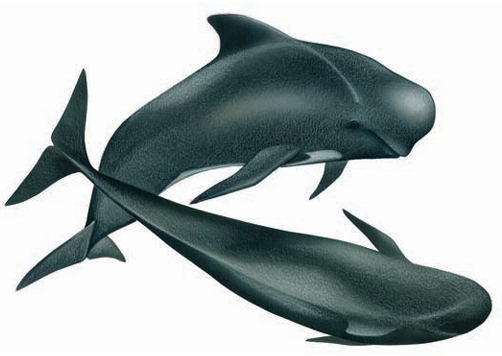
Short-finned pilot whale (© Wurtz-Artescienza)
Physical description and behaviour:
Males reach 7.2 m and females tend to be shorter, reaching 5.5 m. Both are of black or dark brownish-grey colour, apart from a light grey anchor-shaped chest patch, a pair of parallel slanting light streaks and a grey saddle behind the dorsal fin. The species has a bulbous head which may appear square in adult males. It also has an indistinct beak, long sickle-shaped flippers and a falcate, low dorsal fin located one-third of the way from the head. The flippers are smaller than 20% of the body length, which is shorter than their relatives the long-finned pilot whales.
The species is very sociable and are adapted to mainly feed on squid due to their reduced tooth count – linked with suction feeding (Werth, 2000) – although they can also feed on fish.
Distribution and abundance:
Short-finned pilot whales’ distribution is thought to depend on seasonal and annual changes in productivity and temperature (Pardo et al., 2013). They can indeed be found in tropical to warm temperate seas worldwide, and are common in the West Indies, Azores and Canaries. They rarely range north of 50°N and are though to hardly be present north of Africa, although it could be overlooked due to their similarities with long-finned pilot whales. Several individuals have also been found stranded in the south-west Atlantic French coast between 1966 and 2012.
The ASCOBANS range states included in their distribution can be seen in the Geographic range map below.
IUCN Red List of Threatened Species™ Assessment
- LC (least concern) 2023 Europe Assessment
- LC (least concern) 2018 Global Assessment