
Rough-Toothed Dolphin
Steno bredanensis
Rough-Toothed Dolphin
Steno bredanensis
Rough-toothed dolphins are a tropical species inhabiting all oceans worldwide. It is rarely found in the northern Atlantic Ocean and only a few sightings have been recorded in the north east Atlantic.
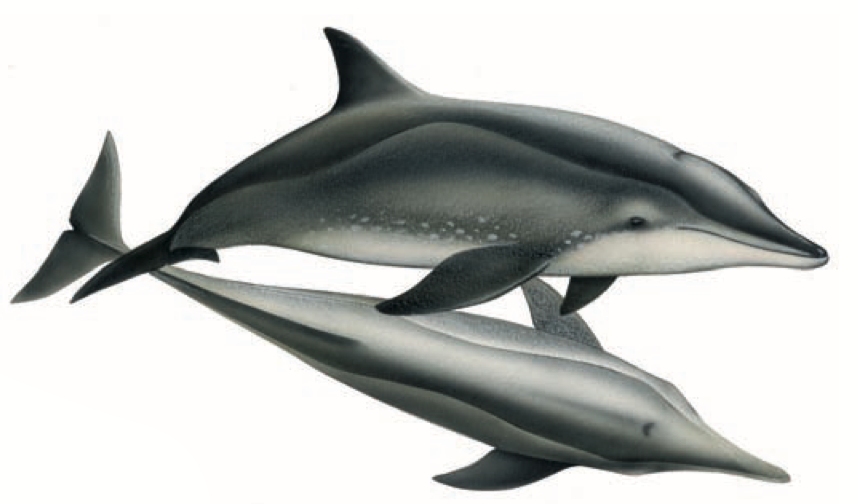
Rough-toothed dolphin (© Wurtz-Artescienza)
Physical description and behaviour:
Adult rough-toothed dolphins measure between 2.5 m to 2.8 m length and have the typical delphinid body shape. Individuals does not have a demarcation between their melon and beak, which is fairly long. The species’ body colour is dark grey and turns white or pinkish on the belly area as well as the lower jaws and lips. The dorsal fin is slightly recurved and stands rather tall and erect. The flippers set further back than most dolphins, are dark grey like the back and are relatively large.
Little is currently known about this species’ behaviour globally, although more research seems to be currently undertaken especially in Brazil. They are believed to feed on fish and cephalopods (IUCN).
Distribution and abundance:
Rough-toothed dolphins are usually found in deep offshore waters but they may also be seen closer to the coast. They inhabit subtropical and tropical waters globally and there are very little population estimates.
There are only two – maybe three – records of rough-toothed dolphins thought to be in the ASCOBANS Agreement Area, namely from the Ghent area in Belgium (1825), one potential north of Paimpol in Brittany (1889) and a last one from Brest in Brittany (1983). The ASCOBANS range states included in their distribution can be seen in the Geographic range map below.
IUCN Red List of Threatened Species™ Assessment
- NT (Near Threatened) 2023 Europe Assessment
- LC (Least Concern) 2018 Global Assessment
Threats:
Bycatch or injuries from fisheries are thought to be the main threat, especially longlines, purse seines and drift gillnets (IUCN).
The preceding information on odontocetes found in the Baltic Sea, North Sea and Northeast Atlantic is derived partly from “European Whales, Dolphins, and Porpoises, Marine Mammal Conservation in Practice” by Peter G.H. Evans (2020) and supplemented by other sources, such as the IUCN species pages.